

ACTING 2
Stanislavski

Konstantin Sergeyevich Stanislavski
Константин Сергеевич Станиславский
1863-1938 Moscow
Stanislavski was a Russian actor and theatre director who's life goal became to show naturalism and realism on stage and make the performance believable by concentrating on the characters feelings as motives. His techniques are still used today and even though they might have been reformed and renewed, they are still the base and holding pillar of most plays.
-
Emotional Memory – Actors recall personal experiences where they felt similar to their character to evoke genuine emotions in their performance. For example, instead of just trying to be sad, they can think of a loss of their loved one in details, recalling the noise, smells, colours they experienced to create a vivid memory, which will naturally alter their mood and show on their face and body language. This was later used by Lee Strasberg, who used this technique as a base for Method acting, which meant the actor fully immersing themselves in their character’s life and acting like them even outside of rehearsals.
-
The Magic If – This technique can open actors eyes and promote empathy by placing themselves in other peoples’ shoes. Thinking about questions like "How would I react as a young teenager if my mum suddenly died?" or "If I could travel to any country, which one would that be?" improves actors imagination, makes them think about the situation and answer naturally and truthfully, therefore their performance will be honest too.
-
Objectives and Super-Objectives – Objective is the short-term goal of a character in a story, for example: "I want to escape". The Super-Objective is the main goal , ultimate desire or long-term motivation. The super-objective can be that our character want to be free , mentally and physically. Understanding these two will help the actor micromanage and understand the actions needed to achieve these goals.
-
Given Circumstances – This simple means analysing the script and picking out the obvious details about the characters, while understanding their basic details, such as woman, born in 1938, rich, beautiful, widow etc.. but also understanding their background and their relationships with others. Is the character kind to others or horrible? Are they honest or wearing a mask in front of other?
Techniques/ The System
END OF YEAR PROJECT/ WHAT I`M AUDITIONING FOR
The information about the end of year project has been revealed to us. We know that we are doing a comedic piece which will probably be refreshing for us and for the audience as well, given that our last two shows were drama.
As an introduction, we watched a few translated versions of Anton Chekhov's comedy sketches. My first reaction was that the actors were amazing, their problems felt real and there were some good jokes in there. However, it felt long-winded and over explained and I am certain that with today's attention spam, it will be difficult to capture the audience's attention with this style of play.

ANTON PAVLOVICH
CHEKHOV
1860-1904
RUSSIA

Anton and Olga on their honeymoon
"Medicine is my lawful wife and literature is my mistress". Chekhov
Anton Chekhov practised as a medical doctor while he became one of the world's greatest playwrights and authors. Even though he lived a very short life, dying at the age of 44, he produced much work and his 4 plays ; Seagull, Uncle Vanya, Three Sisters and Cherry Orchard were the birth of the early modernism in theatre.
Anton had a troubled childhood, with an abusive and unreliable father, a broken spirited mother and 5 siblings. When his family went bankrupt and moved to Moscow, he stayed behind and worked for many years to support their living. He lived almost all his life alone as a bachelor and even when he married Olga Knipper in 1901, they never lived together. Olga stayed in Moscow, working as an actress, while Anton lived in Yalta. Anton very much enjoyed being single and he only agreed to the marriage if his freedom was provided.
"...give me a wife who, like the moon, won't appear in my sky every day." Chekhov
They only spent 3 years as married before Anton died from an ongoing tuberculosis.
The plays we will be concentrating on are his comedy sketches e.g. The Bear, On The Harmfulness of Tobacco, The Proposal and A Reluctant Tragic Hero.
Common in all four of them is that they all satirise ordinary people by exaggerating their flaws, weaknesses, obsessions and vanity. Concentrating on people's small, sometimes ridiculous problems is what makes these stories so real and relatable. While I was watching the Hero I wasn't sure whether I should laugh or cry because his life as a man was portrayed so realistically and it made me reflect on how much my husband do for us.
Sketch comedy is a type of comedy made up of a series of short, self-contained scenes, often referred to as sketches, which usually last only a few minutes. These are typically performed by a group of actors and can be presented on stage, radio, or television. Each sketch is brief and independent, built around its own central joke or concept.
It often features a variety of characters and settings in each segment. Some sketches are fully scripted, while others may include elements of improvisation.
This form of comedy originated from 19th-century entertainment styles such as music hall and vaudeville. Early contributors, including theatre producers like Fred Karno, helped develop the structure of this format. Well-known performers such as Charlie Chaplin also began their careers in similar comedic styles.
Over time, sketch comedy expanded from live theatre into radio and later television. It became especially popular in the UK and the United States through shows such as Monty Python’s Flying Circus, The Benny Hill Show, and Saturday Night Live.
Many of the techniques used in sketch comedy—such as exaggerated characters, punchline-based dialogue, and quick comedic setups—are also fundamental to sitcoms. In this sense, a sitcom episode can sometimes resemble a series of loosely connected “mini-sketches,” each built around a specific joke or situation, but tied together through a continuous storyline and character relationships.
A clear example of this can be seen in The Big Bang Theory. The show often structures its episodes around multiple short comedic situations, such as misunderstandings between characters or socially awkward interactions, particularly involving Sheldon. Each of these moments functions similarly to a sketch, with a clear setup and punchline, yet they are woven into a broader narrative that develops across the episode and the series as a whole.
Chekhov's Gun
“One must never place a loaded rifle on the stage if it isn’t going to go off. It’s wrong to make promises you don’t mean to keep.” Anton Chekhov
If an element is introduced in a narrative, such as a gun, it should have a purpose later in the story. Otherwise, its presence may feel unnecessary, leaving the audience questioning why it was included at all, as it does not contribute to the plot or character development. This can result in a sense of dissatisfaction or frustration for the viewer.
I recently watched the series Harlots on Netflix, where two guns were introduced. One of them, originally held by Margaret Wells, was later used by her close friend to kill the man responsible for her daughter’s death, giving it clear narrative purpose. However, another pair of guns, given to Emily Lacey by her keeper, were never used. I found this frustrating, as I kept expecting them to play a role later in the story.
Meeting the script
We started the work by reading through the scripts and explaining what we understood from them and how we perceived the characters. We understood that these are comedy sketches, supposed to be funny and the comedy will come from a mix of the characters being relatable with real problems but telling their side of the stories in a theatrical, exeggarated way. The characters constantly seem to throw a tantrum, being on edge and presenting heightened emotions.
My characters
I will be appearing 3 out of 4 plays, portraying
Elena Ivanovna Popova from The Bear
Stepan Stepanovitch Chubukov The Proposal
Alexey Alexeyevitch Murashkin from A Reluctant Tragic Hero
Popova
Elena Popova is a wealthy widow who lost her husband 7 months ago and appears to be so sad about it that she has been wearing black and haven't left the house ever since. However, as the story unfolds, we find out that she is living in solitude out of spite to prove to her late husband what "real love means". She found out that her late husband cheated on her multiple times and it hurts her so much that she becomes ridiculously stubborn. She immediately breaches her promise when she starts developing feelings for the first man who walks through her doors. Even though they seem to disagree and hate each other, their quarrelling turns into a passionate fight and ends in kissing. Grigory finds her stubborn and brave nature attractive.
Chubukov
Chubukov is a proud, old, conservative man, the father of Natalya, and intends to marry his daughter to their neighbour who he dislikes but is willing to accept as his son in law for his status and land. He acts polite but often loses control and becomes aggressive and hypocritical. There seems to be no logic and thoughtfulness behind his words.
Murashkin
Murashkin is the friend of Ivan Ivanovich and portrays the rational character in the play. He is a calm listener and sensible person who is able to and willing to listen to Ivan`s outburst for a very longtime, without cutting in, even if he finds it over dramatic. The who play takes place in his study where he never kicks Ivan out of. Towards the end of the play, he becomes happy to hear the name of Olga and asks Ivan to take some parcels for her, which sets up Ivan on his final outburst. This crowns the comedy and shows that perhaps Murashking doesnt think Ivan`s problems arent as big as he explains. He also questions him at the beginning saying how could his life be so bad when he has a good job and a loving wife.
"Two's company, three's a crowd."
(How can I play 3 different characters in one night?)
I find this overwhelming, not only because of the amount of script I need to learn but also because I am expected to show 3 completely different characters. The biggest challenge is going to be for me to play 2 men and make them both different in speech, movement and looks. At the moment, my idea is using a higher pitch feminine voice for Popova, my normal voice for Murashkin and a deeper voice for Chubukov. I find it extremely hard to portray older characters as my grandparents have never been around me in my childhood so I have no memories or stories from them.
Do svidaniya Chekhov (Goodbye Chekhov)
After a few run-throughs, it has become unavoidably evident that the group's heart wasn't in this project. Unfortunately, we didn't fall in love with Chekhov's work. We all had different problems with him. I personally didn't like the translation of the comedy sketches. I found them hard to remember, and there were too many repetitions in the texts. They felt like having to read 20 pages for a couple of jokes. However, I wasn't going to complain, out of respect for my teachers and purely because I know that in life, there are many situations where we have to do things we don't want to. Yet, I am grateful for our teachers for not forcing the project on us. However, this put me in panic mode because I realised that we only have about 4 weeks left until the Create 26 festival and our show. Luckily, our teacher, Spike had an idea, which required no script, no hours spent alone learning monologues but instead it focused on movement, ensemble and team building.
He introduced us to the story of the Highwayman, who was a fallen soldier, a respected officer, who when losing his job, turned to highway robbery, gaining name and fame for himself. But one time, he made a mistake, his gun got jammed and he got caught and executed. Our teacher started writing the story for us, to show us his vision on the language and mood. We then took the ideas further and wrote the rest of the script with the help of AI. I wrote quite a long prompt for AI, then Tom and I corrected anything we didn't agree with manually.
Here is the prompt:
We need to tweak this story around. We'll start with him being ready to be killed, perhaps including that his face mask(bandit bandana) is off.
Then when it goes onto the bit where it says, we'll say that he was a soldier and he fighted well, this is how he ended up being an officer.
I was thinking how to include the bit we were practicing on Friday because it seemed like the ending. So, in the first bit, where we talk about how he was a soldier, we will show a fight scene between me and the puppet and he'll have mercy on me. Then at the end, I will have mercy on my enemy (Mike, who fights for the same team as the puppet used to). We have to come up with 2 colour for this e.g. the puppet flag is blue and the enemy is yellow. They'll have a piece of fabric on them, so we can show the difference between the teams.
So, starts with him about to get killed, then he thinks back of his story; fighting as a soldier, mercy to the soldier, then becoming an officer (we'll put a medal around his neck to show this, perhaps we'll change his hat as well).
Then we going to show him arguing with another officer. Then we'll have the letter pass around game, where he'll get a task that he hesitates to complete because he knows it would be risky for his team. We'll show them fighting again and soldiers dying (horrible alarm, gunshots, smoke) and he gets blamed and kicked out and sent to the workhouse for it.
At the workhouse , we'll watch him do sweeping , digging (whatever the puppet can do xddd) day and night (this can be achieved with the changing of lights). Then on a stormy night, he will break free, steps outside, and enjoys the rain falling on his face, he is finally free.
Next scene is, we see him getting a gun (one of the actors give it to him) then we'll show a man riding a carriage and he successfully robs him. Then he does a second robbing. This will be a fine lady (she screams, she is scared) as she would hand over the money, the puppet drops the gun and police appears hearing the lady's cries and they take him away.
Now, we are back to the beginning where he is waiting for his sentencing. There's a final picture of the battle field, where I (the enemy) have mercy on Mike(same team as the puppet) to show that he taught kindness and mercy to the enemy, so did something good in his life. Then the rope tightens around his neck and he gets killed.

One difficulty of this project is that the Highwayman will be a puppet, controlled by two actors. We chose Yana and Faith because they are the same height. This should help them hold the puppet in place safely, without straining, since their shoulders are the same height and neither of them pulls the other upwards. Thomas will be our narrator, reading the story live, so that leaves me and Mike to fill in any other roles on stage and interact with the puppet.
This is something we haven't done before, and it is more difficult than it sounds so we started working on it straight away. The puppet is being controlled by two individuals who are expected to breathe and move as one and to show a variety of movements and emotions, with the puppet having a white face and no facial expressions.
My biggest challenge is having to treat the puppet as a real person. I have a scene, where I have a sword fight with him. I organised a workshop for us with Matt Kuter, who`s hobby is fencing and one of his projects were stage fighting at university. He thought us some basic movements and sword handling and then showed us his routine that he can reuse in any scenes. I thought it was too complicated for us so I made it simple, using only 6 moves that we then kept practicing. Later on tried it with the puppet and miracely, it worked. I just have to make sure that I am looking at the puppet and not the actors controlling it.
Puppetry
What is a puppet?
A puppet is a figure, often shaped like a person, animal, or mythical creature, that is controlled by a puppeteer.
Puppetry has a long history and was practiced in both ancient Greece and India. The earliest written references to puppets appear in the works of Herodotus and Xenophon during the 5th century BC. The Greek word for puppet, nevrospastos, means “drawn by strings,” reflecting how puppets were controlled.
The philosopher Aristotle also mentioned puppets in his writings, comparing the movement of animals to that of mechanical puppets operated by strings and levers.
In India, puppetry has been practiced since ancient times. Evidence of this tradition comes from clay dolls discovered at sites of the Indus Valley Civilization. Puppetry, known as Bommalattam in some regions, is also referenced in the ancient Tamil work Silappadikaram, which dates to around the 2nd century BC.
Puppeteers bring puppets to life using their hands, rods, strings, or other controls to move different body parts. They often provide the puppet’s voice and coordinate its movements to tell stories and entertain audiences.
There are several types of puppets, including finger puppets, hand puppets, sock puppets, rod-hand puppets, live-hand puppets, marionettes (string puppets), shadow puppets, Japanese Bunraku puppets, ventriloquist dummies, and large carnival puppets used in parades and performances. Each type differs in how it is operated and the level of complexity involved.
Simple wooden marionette style mannequin puppet


Hand puppet for children's show

.webp)
Marionette puppets
Muppet Puppets


Puppets on the stage of the West End theatre, London


Our puppet

The puppet was a semi-rigid, semi-moving element of our show. It had a solid spine made out of wood with a handle at the back, so it was easier to carry it around. The jacket was sitting on a wooden clothes hanger. It had a scarf and a white shirt to add layers and textures. The sleeves of the jacket were cut open where the actors could slide their hands in, creating functional arms and grip. The head was made out of a wooden frame and a white mask with a top hat on. We originally wanted a pirate style hat, the we ordered, but that couldn't cover the wooden frame so we have chosen the top hat. We thought about changing its hat between scenes but no other hats were deep enough to fit the frame inside.
The puppets head was controlled by one of the actors and was able to look up and down, left to right, shake its head and create the illusion of looking at objects or actors. With the arms being the actors` arms , it was able to sweep, sword fight, touch, grab, hold pistol and even small jewellery.


Sweeping
Shooting


Holding
Pleading

Fighting
Minimal set/ prop

The set was minimal but large. We didn't feel the need of having much set for this production. However, there were key stations/sets that we could reuse and revisit throughout the play. The chest was used for sound effect, as a box and also as a carriage the Highwayman robbed. It also contained all of our costumes and small props between rehearsals. It was important that we didn't lose any of the small props because if we did, or misplaced anything, the play burst into panic and chaos. So, Mike and I made sure to reset everything between rehearsals.
For the horse, we used taxidermy (stag head) and we just let the audience suspend their disbelief. The bus seats were used at the beginning as chairs and towards the end of the play, as a horse ridden carriage, with the rider at the front and the passenger at the back. We tied blue ribbons on the antlers of the stag, those resembled the whip for the rider.
The stag was placed on black boxes and the front was covered with an old looking rug.
The riders seat was covered in brown sacks, while the passenger seat was covered in red and orange shiny materials, suggesting that the lady travelling at the back was wealthy. The read silky seat cover was actually a robe that I could quickly put on for the scene and swiftly remove it at the end of the scene.
We had some small jewellery, had to be placed in Mikes jacket and a white cloth that had to be placed in my army officer jacket. Later on, that white cloth was reused as a white flag by the puppet. There was a broom used to represent the puppet being sent to the workhouse, where he was forced to sweep day after day.
We also had a couple of swords and a couple of guns that we kept reusing and moving around between scenes. It was very important for Mike and I to remember where we supposed to place these reoccurring items.

Chest/carriage
Wearing the silky seat cover


The puppet using the broom
Horse ridden carriage
Suggestive costumes
We all dressed in stage black (black leggings, black boots and black t-shirt in my case). This allowed us to quickly put on and remove layers when needed. For example, when played the army officers, we put on an officer hat and long trench style coat/blazer. While I was fighting, I had yellow fabric wrapped around my wrist, signalling that I am in fighting in the opposite team. I was wearing the silky red robe, when I played the wealthy lady and gave my ring away.

Stage black

Silky robe and red bandana on the puppet

Yellow cloth on wrist

Simple army officer outfit
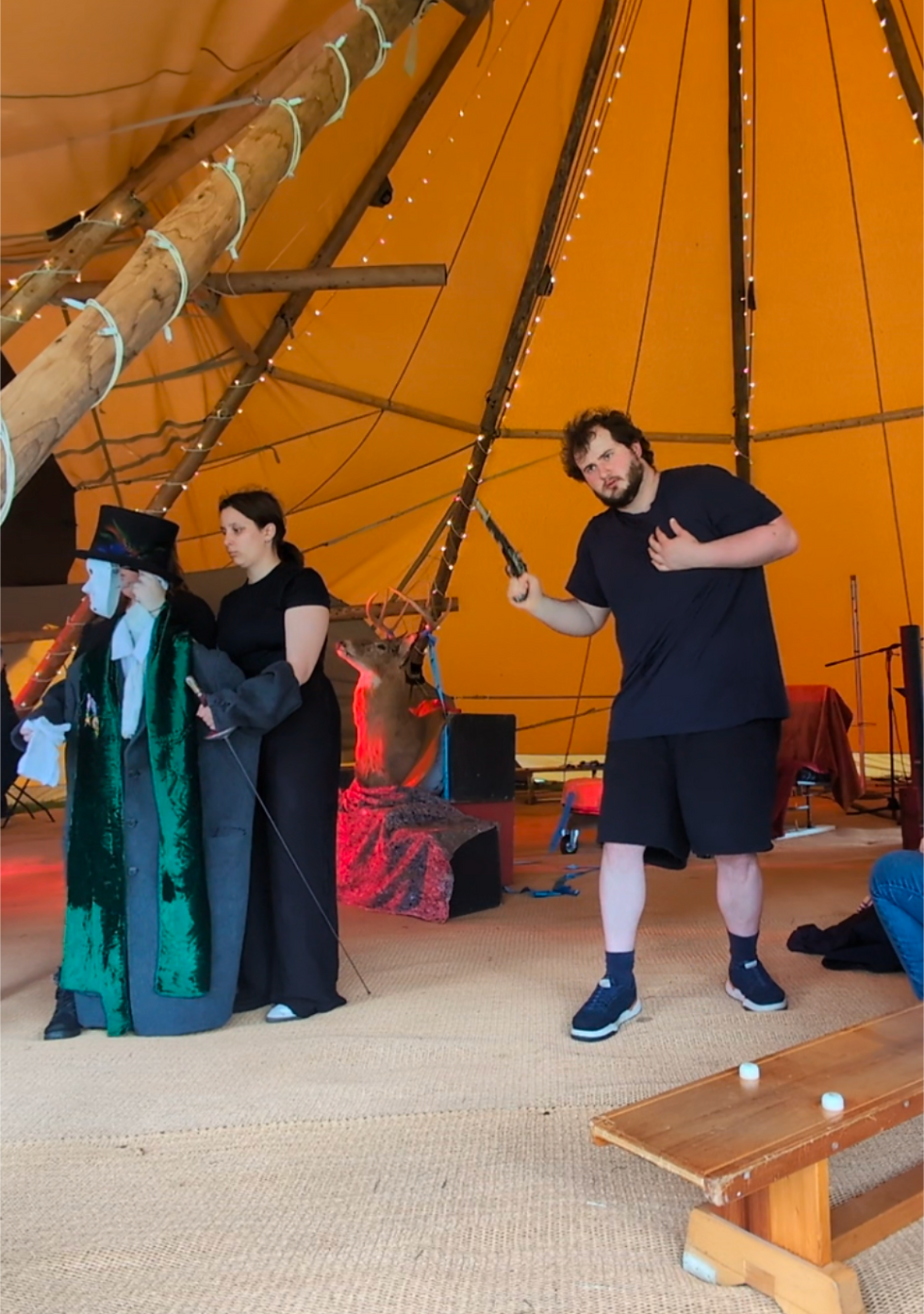
Shiny green drape and medals on the puppet
On the day
We arrived at 10.30 am, to run the play with some side effects for the first time. Then at 1.30 pm we started to carry our large set outside to be ready to perform at 2 pm. We then stayed in the tent, listening to the performances of the Level 2s. I also had a last minute request to help to support Faith on stage while she was performing a monologue from The Reluctant Tragic Hero. I had no lines, I just had to react to what she was saying and had to pass her a cup of water. I was mainly there for emotional support and so she had someone to aim her monologue at. Then at 3.30 pm, we performed our play again and it was a wrap.
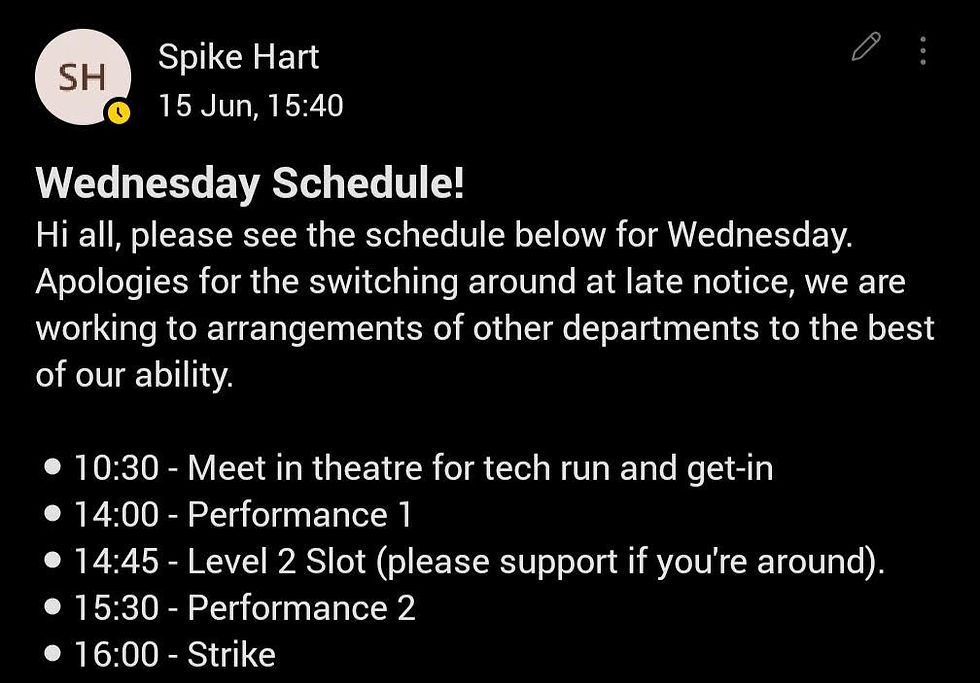
Call sheet
The stage
I was nervous performing outside, in the tepee tent because we hadn't had the opportunity to rehears outside. Our set didn't fit on the stage so we cleared a large area on the ground and put benches around us, in a half circle. Unlike inside the theatre, we weren't facing exactly foreword, we ended up on more like an angle, which completely threw me off-guard. I became disoriented and blanked while I was sitting on the chest, thinking what comes next. I was convinced we jumped in time and I just haven't caught up yet. Luckily, I started listening to what Thomas was reading and that reminded me of the next scene. This hasn't happened the second time we were performing but I was afraid it would and it stayed in the back of my mind. I also had to be careful during the swords fights because the audience was very close to us and I fell right next to their feet. Other obstacles were the pillars, the sound table with the equipment and Thomas narrating behind us. Overall, no major mistakes happened and no trips or falls, we stayed safe. The tent was a beautiful place for our performance and it set a festival like mood for us and the audience.

Tech table at the back
.png)
Stage with the pillars visible

Thomas narrating behind the seats
Recording of the show
Feedback
I hadn't had time to look at the faces in the crowd but we received a big cheer at the end of our play and we had students coming to congratulate and high-five us. I also asked a couple of my friends what they thought and they said it was "cool". I was afraid that younger people and teenagers wouldn't be able to appreciate this type of performance as they couldn't understand how much work went into the making but they positively disappointed me.
Our teachers told us that the audience was very attentive, they were watching us carefully and they also heard positive whispers about our play. Sonia (one of our teachers) told us that she really liked how concentrated we stayed and we had our actors face on, making us look very professional. Spike (other teacher) told us that he was proud of us for how quickly we managed to put the show together and how well we took the challenge of performing on an unknown stage.
I wasn't sure whether I would like this play at the beginning but I grew to like it and enjoyed story-telling via movement only. I think I learnt discipline, organisation skills and self-confidence on stage. It made me understand how dancers feel on stage when they haven't got their voice to represent themselves, only their face and body.
Research material: