


I have been assigned to work as a costume constructor on our upcoming murder mystery show.
But what does this mean and why is it important?
The process of creating characters in a theatrical production's visual appearance is known as costume design. Costume designers work closely with directors and know the storyline in order to assist the actors in creating their characters. This is important because the characters' appearances can change throughout the show, for example, if they are rich at the beginning but later on become poor, it must be visible. Another factor is the time and place of the play, whether it is in the Victorian era or in the modern world. The age of the characters also needs to be considered when designing costumes for them. By wearing the right clothing, the characters become more convincing and the audience can identify hidden clues about them.
While the designer makes the ideas, costume constructors execute them, although in many cases this is carried out by the same person. Costume construction is the making of the costumes, whether it is from scratch or altered from existing pieces. Materials and fabric are manipulated to create suitable clothing for actors.
What are the skills required for this role?
-
designing skills
-
attention to detail
-
team work
-
work well under pressure
-
creativity
-
good fashion taste
-
communication skills
-
great handwork skills e.g. drawing, sewing
-
knowledge of online designing tools
The first costumes

Believers of God think that Adam and Eve were the first people to devise and wear costumes (clothes) when they made pants from leaves to cover themselves.

In ancient Greek plays actors wore carved masks while performing. Actors usually portrayed more than one characters and the masks helped the audience identify which one they are currently playing. They had exaggerated facial expressions to make the characters emotions clear.


In England, fancy dress was popular during the Tudor and Stuart times. They were influenced by French and Italian plays and involved dressing-up, dancing and dramatic storytelling to entertain the monarch. Their costumes were a mix of earlier folk customs and court pageantry. Henry VIII' enjoyed the plays himself and often got involved in the productions, even dressing up at seasonal festivals.
If we talk about costumes and masks, we must mention Venice. From the 1690s for about a hundred years, mask-wearing was part of their life for half the year. By the 18th century, their carnivals become popular all over Europe and also interested British visitors.
Queen Victoria enjoyed costume parties and held many. In May 1842 she held a grand Bal Costumé for 2000, aiming to support the Spitalfields silk industry, saving it from closing down. Their themes were Georgian and Restoration themes.
Queen Victoria and Prince Albert in period costume, oil sketch by Winterhalter, 1851
Today, most people dress up for Halloween as a scary spirit. Halloween is an American celebration, however it is likely to come from the ancient Celtic festivals, which marked the end of summer and the harvest. They said that this is the time when the worlds of the living and the dead were brought together by the gates of the Hell opening. Witch burning practices also spread across the world, where it has been said that their souls would often come back to haunt their betrayers. Traditionally, in Hungary, where I was born, instead of Halloween, they celebrate "The Day of the Dead" or "All Souls' Day". This is an intimate holiday, where families visit their local cemeteries, light candles and bring flowers to their loved ones' graves. Usually in February, schools hold a fancy-dress day, called Farsang, where children create devised shows with the help of their teachers, make costumes with their parents and perform a show for the whole of the village. This can be of any topic, not necessary to be scary. Farsang used to be a carnival for chasing away the winter and celebrating the arrival of spring.

Farsang in the past Farsang now

Other times when people wear costumes or "dress up" nowadays are, of course, modern theatres, TV shows, Christmas, prom, funerals, interviews and special occasions, such as birthdays or wedding days. All of these days have a dress code that should be followed by all participants.


Halloween costume


Trick or treat
My class have been commissioned to make an engaging and creative murder mystery show for Christmas to raise money for Gloucester Welcomes Refugees Charity. I will be taking on a costume construction role. We know that most characters masquerade as animals but most of them also have titles such as general or priest so there needs to be a fusion done. I have to choose at least one piece of costume to make or alter. I started the work by going through the costume cupboard of the college and selected potential pieces I can work with. The clothes I saw there acted as my stimuli. The other benefit of finding something suitable there was keeping the cost down.
Costume for The Dragon


Mood boards

Measurements


I also measured the sleeve length of the dress, to double-check my arm measurements. The numbers were similar, meaning I will be working with the correct information.
57 cm
40 cm


Test piece- testing the performance of the machine, the workability of the material and the accuracy of the thread colour
Showing my vision on the pattern


Measuring the sample piece I used to demonstrate the sleeve.
96 cm
First update on progresses made



Stitch types

I have considered using fancy stitch types, however I realised that there is no benefit to it in my case. I had to do a significant amount of hand sewing so these would have slowed me down and because of my thin material, I was using a thin thread and these stitches look more breathtaking when using a thick thread. To prove my point, I took some thread and folded it 4 times to add some volume to it. I am displaying the stem stitch here.

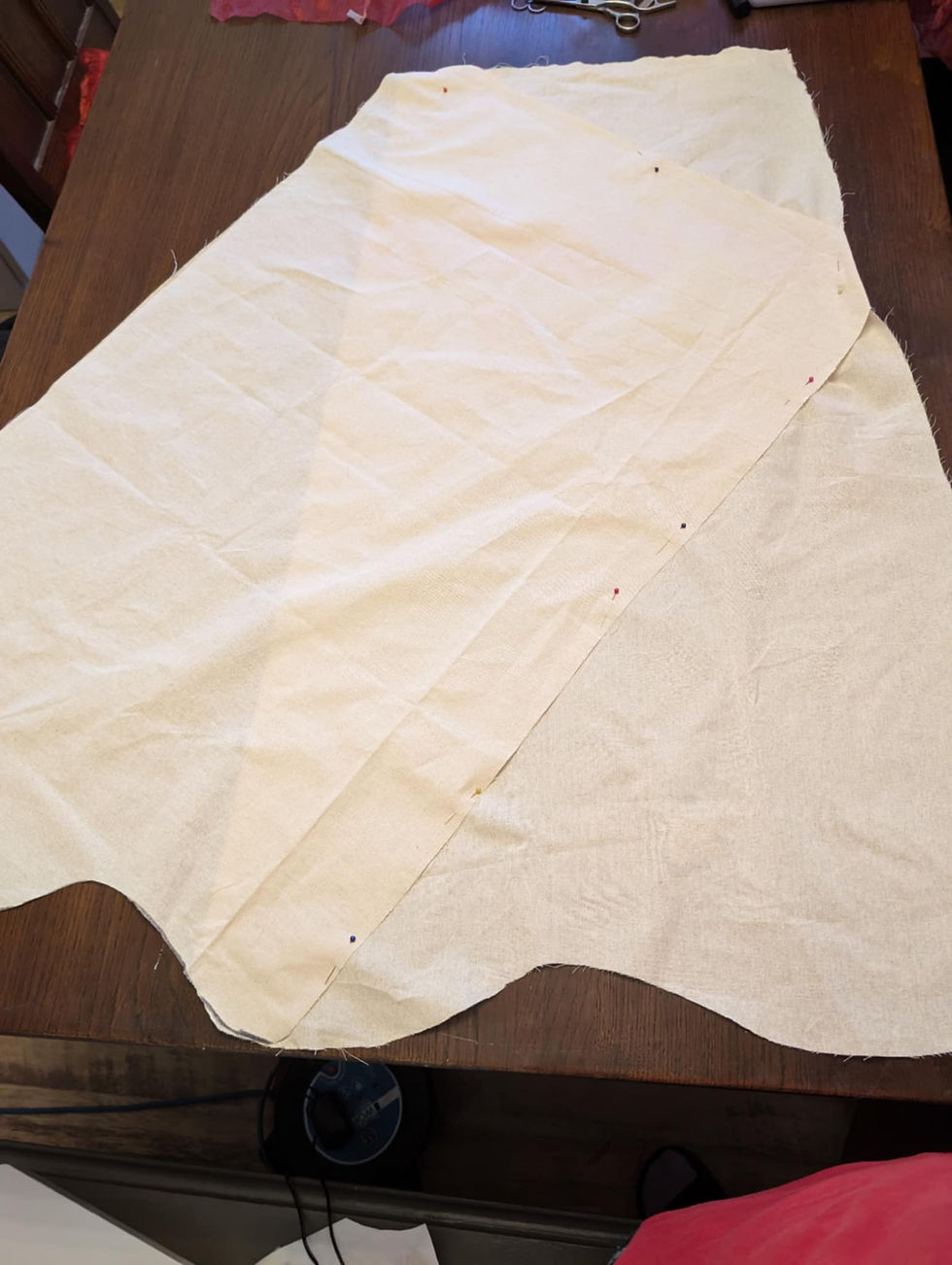
A failed attempt is part of the progress, so I am sharing my "pipe dream" idea with you. After cutting the organza material, I wanted to leave a raw edge on the bottom. However it started fraying so I decided that it needs to be fixed down, otherwise it will catch on something and the whole piece will be ruined. My idea was to use straight-stitch on the sewing machine but sadly, I have already attached the sleeve to the dress so while I was feeding the material through the machine, I was also dragging the dress with it, which was very heavy and often slipped off the table, ruining the stitch line. I took the stitches out and tried again a few times but the same problem occurred all the time. The other problem was that I left the bottom of the sleeve wavy and it was very hard to follow along with the sewing machine. So my next idea was to hand sew it but it took hours and hours and once again I struggled with being able to do a nice enough fold because of the waves in the material. So I took all the hand stitches out , which wasted more of my time and I became very upset with the whole project, as I knew that I have been trying for so long and there were no positive results. I have considered stopping, ditching the idea and making something simpler.
"Pipe dream"

Attaching the organza material to the existing sleeve with the sewing machine resulted in beautiful, uniform-like stitches. However, I couldn't find a way of separating the two sides, so they always stuck together, resulting in being unable to put my arm through it. So, I took the stitches out and had to hand sew it on.

Sewing by hand wasn't the easiest either. I am unsure of the reasons but the thread kept twisting, many times tied a knot on itself. This significantly slowed me down because every time it happened, I had to cut the thread and start my stitches again.
Plan B (more like plan Z)
I chose to have a last attempt with this piece before giving up and decided to try to use the hemming tape and glue down the raw edges. I did not expect this to work because the material is extremely thin, I believed I would burn through it immediately. This was a very risky attempt because if I burnt the piece, I had to start all over again. So I decided to test the process and used a left-over test piece. Surprisingly, it worked out fine and in the video you can hear me talk you through it, step-by-step.
I previously mentioned that I was thinking about attaching a wrist band on my material, so I did. This will allow me to have a better control over the dress by moving it from the wrist not from the elbow. Better control will result in more delicate and elegant movements. I simply took my previous wrist measurements (15.5 cm), cut the rubber to size by leaving a 2 cm overhang and hand-sewed it on.
After attaching the wrist bands, a new problem occurred, the blinding white colour of it. Because the sheer material is very thin and see-through, I knew I had to change them red. Luckily, I already had plenty of paint at home so I chose the one that was the closest in colour. I took one of my painting brushes, which was the perfect width to work with and it ended up being a quick and effortless change. Once the outside dried, I also painted the inside of the bands as well. Meanwhile, I realised that it would have been easier to do paint before attaching them to the material, by cutting the bands to size and laying them flat on the table, this is a lesson to be learnt for next time.
Summary and the finished product


Evaluating the dress after the performances

Character masks
.jpeg)


I had to remove the sound from the second video because I was working at college and everyone was busy with their own projects, so there was too much background noise, so I will explain what happened.
In the first video, Faith and I started altering the masks by cutting off the rubber bands and gluing wooden sticks on the masks with the help of the glue gun. I owned both of them, so it was a cost effective method. First we were unsure, as this was our first time using it, but it was very quick and easy and we safely glued all the sticks on without damaging anything or burning ourselves. We chose to place the sticks in the middle because we needed a straight edge or at least a piece of straight fabric to line our stick to. The other benefit is that this way, the weight of the masks is the same on both side, while if we glued the sticks to the one side, it would have had to hold the whole of the masks, risking it to easily breaking.
We waited for them to dry and realised that the masks are quite heavy for the sticks so I applied more glue, gluing the stick to the bottom of the mask too. This made the stick sturdier. The wolf mask asked for special attention because we made it for a classmate who uses a wheelchair and is unable to lift his arm too high. So we spoke to him and made sure that he is comfortable with the length of the stick. Because his fine motor skills do not work fully in his hands, we had the idea of doubling the sticks so he has a better grab of the piece of wood. Because we wanted to maximize the length of the sticks, we glued them right at the bottom of the mask, which resulted in the whole of the masks to be very bendy and the weight tilted to whole thing forward. So I added two more sticks and the full mask was now supported with wood, giving it stability. We tried it with our classmate, who was now a lot happier and a lot more confident with it.
Results:


Faith is working on the cloak of Red Cloak, sewing it to make a poncho with a hood. I am assisting on the project, helping her use the sewing machine and answering questions. The material is thick and by doubling it up , it became even thicker. We have noticed that the machine was struggling with it, in fact, we were almost unable to place the material under the pad, so after a few failed trials, Faith has decided to handsew the piece.


Before brushing
I painted the faux bird feather by using 3 different colours: a medium sky blue as the base colour and then added white to it to lighten the tip and added dark to it to paint the base. After painting it, the feather looked wet and it stuck together so I used a fine brush to separate them and make it fluffy again. Sadly, the seam of the feather did not take the paint at all but I believe that is still looks presentable.

Bluebird hair clip

After brushing
We considered different materials to create the priest collar. First, we thought about painting a piece of cardboard white, then we found a piece of cardboard that was already white. However when I took it to college, it didn't look bright enough under the theatre lights, more of a dirty white. So I found a piece of plastic strapping, which was much whiter. We had rubber bands leftover from cutting it off the masks so I attached that to the plastic piece with a glue gun after measuring the neck of the actor, Kian. However, when he tried it on it looked too thin so I doubled up by gluing the piece of strapping on a cardboard and gluing a second one underneath. This made the collar look much visible while we were still able to hide the rest of it under his black shirt collar.
Priest collar
Feedback
"The Dragons red dress I thought was done brilliantly and very professionally. The colour scheme with the red representing the dragon, yet also love and passion fits the Dragons character perfectly. The “wings” sewed onto the dress is a really effective and subtle way to bring the dress closer to resembling a dragon. I thought the dress also fit the setting of the show, that being a 1920s masquerade ball. Looking at parties that took place in the 1920s, all the women seem to be wearing quite elaborate and flashy dresses, while the men wear suits. I think the costume department has done a very good job with everyone's costumes, despite our small budget, to try and best represent that 1920s era of fashion. Everyone's costumes along with fitting into the setting of the show also fit the characters very well, no one was wearing something that would seem out of place for them and the colour coordination with the characters was very effective. Having the bluebird wear blue, the dove wear white, the stag wear brown/ grey, the dragon wear red etc. Was really effective at distinguishing the characters from each other, which should’ve helped the audience even more when it came to figuring out the characters and who committed the murder in the show. The masks everyone was wearing were good and were effective in showing which character they were masquerading as. With a higher budget or more time I think the masks could’ve been better, but we’ve got to work with what we have and considering that, they were very good. The masks being inconsistent from each other wasn’t a big issue, but I think having a group of them be in the same “realistic” style and others not, just stood out a bit too much. I think If the masks were either all the same style or all mostly different styles then that could’ve worked better. Considering we set the show in the 1920s, I think a lot of the masks worked very well. I don’t think the “realistic” masks would’ve fit into the 1920s and if we were to do it again I’d see if we could change them. Though I understand we needed specific animal masks and that it’s quite difficult to find masks that would suit the 1920s and be the correct animals. If we had more time then we maybe could have attempted to make the masks ourselves. Overall I think all the costumes and most of the masks fit into the show we were creating, and I think the costume department did an amazing job, despite the limitations of time and a small budget." Ryan Thornton, Director
"I thoroughly enjoyed this murder mystery show I think the costumes for each individual merged well with their portrayed personalities." Jarid
"Thanks for telling us about the show! It was brilliant! We've never been to an interactive show like that before, we really enjoyed it! Although we must apologise for suspecting you." Sarah
"I liked how each character was designed as a type of animal and even had the personality of their animal The clothing gave like an Edwardian or 1920s or 30s feel However their were some occasions where I lost track on who was what like the stag for instance Maybe a brown or plaid suit could work." Matt
"Costumes, the masks were well designed and could easily make out what they all were. I liked how some of the costumes represented the animal or character they were playing like the dragon having wings with that cape or the hare furry coat." Jamie
Research materials:
https://getintotheatre.org/blog/what-does-a-costume-maker-do-in-theatre/
https://www.cssd.ac.uk/courses/costume-construction-ba
https://www.berklee.edu/careers/roles/costume-designer
All pictures are sourced from Google images